



salento experience
News Baia di Gallipoli Camping Resort
Lecce
What to see and curiosities to fall in love with it
Lecce is a city to be savored slowly: the secret is to always look up, to appreciate the friezes and details of the Lecce stone, but also down, where millennia of history emerges among the paving stones, foundations, and traces of the Roman world. Here's a selection of the most beautiful things to see, including some curiosities that make Lecce unique.
1) Piazza Duomo: the baroque “courtyard”
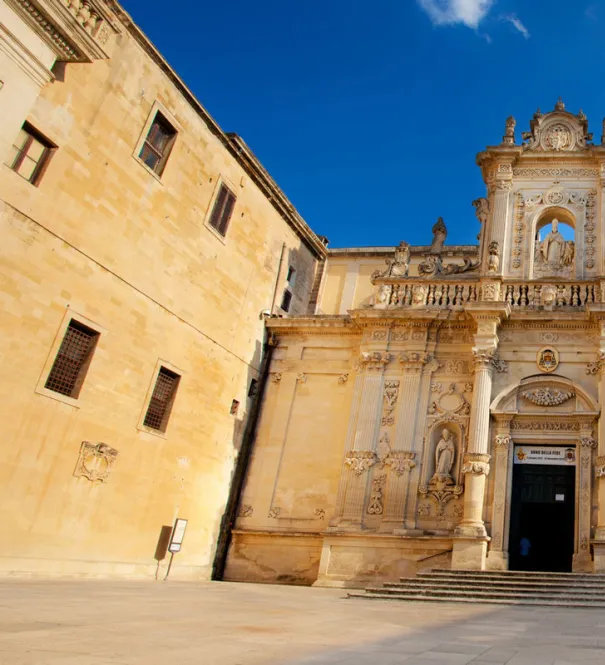
It is one of the most scenic spots in the city and a rare example of an "enclosed" square, almost a monumental living room accessed through a single entrance, the Propylaea. Once inside, you feel like you're in a stone theater, orderly and solemn.
Interesting fact: the Cathedral has two facades, but the one you see upon entering the square is the more "theatrical" one, designed to amaze the visitor; the main entrance is located on the side.
Not to be missed: the Bell Tower, one of the city's symbols: climbing to the top offers a sweeping view over the rooftops, all the way to the sea on clear days.
2) Basilica of Santa Croce: the triumph of the Baroque
If Lecce is world-famous, it's also thanks to Santa Croce. Its façade is an explosion of figures: cherubs, flowers, fantastical animals, and faces sculpted with an almost inexhaustible imagination.
Interesting fact: Among the decorations, unusual and sometimes deliberately "grotesque" details can be seen: according to tradition, some stonemasons left caricatured faces or references to figures of the time, as a hidden signature within the great Baroque narrative.
3) Piazza Sant'Oronzo and the Roman Amphitheatre: the ancient city beneath the steps
Here Lecce shows its two faces: the contemporary one, lively and full of cafés and promenades, and the ancient one, with the Roman Amphitheatre re-emerging in the heart of the square.
Interesting fact: the amphitheater is only partially visible: a significant portion still remains beneath the surrounding buildings, as if the modern city still literally rested on the Roman one.
And right in the square, the column with Saint Oronzo dominates: the statue on display is a copy, while the original is kept elsewhere; the column, according to tradition, is made with elements from Brindisi, linked to the history of the Appian Way.
4) Charles V Castle: fortress and underground
Imposing and austere, Charles V Castle depicts the "strategic" Lecce: defense, territorial control, and power. It's worth entering and not stopping outside.
What to see: In addition to the courtyards and halls, the interior passageways and, when accessible, the underground rooms and walkways are fascinating: a completely different experience from the dazzling light of the Baroque squares. The castle also often hosts exhibitions and cultural events.
5) The city gates: entering the historic center as it once was
To reach the heart of Lecce, pass (even if just for a photo) through one of the remaining ancient gates: Porta Napoli, Porta Rudiae, and Porta San Biagio. They're perfect starting points for a stroll, marking the boundary between the "modern" city and the historic one.
6) An artistic secret: papier-mâché
Lecce is also the capital of papier-mâché, born as a "poor man's art": with paper, water, and traditional glues, artisans managed to create light, durable, and spectacular sacred statues, capable of imitating more expensive materials.
Tip: Take a stroll through the streets where the workshops are located and peek at the work in progress: seeing hands and tools at work is one of the most authentic memories you can take home.
Extra tip: Lecce at sunset
If you can, visit the city at sunset (or in the evening): the Lecce stone changes tone and reflects the light in a unique way, transforming the facades into a warm, almost golden hue. This is the time when Lecce truly seems to deserve all its nicknames.
1) Piazza Duomo: the baroque “courtyard”
It is one of the most scenic spots in the city and a rare example of an "enclosed" square, almost a monumental living room accessed through a single entrance, the Propylaea. Once inside, you feel like you're in a stone theater, orderly and solemn.
Interesting fact: the Cathedral has two facades, but the one you see upon entering the square is the more "theatrical" one, designed to amaze the visitor; the main entrance is located on the side.
Not to be missed: the Bell Tower, one of the city's symbols: climbing to the top offers a sweeping view over the rooftops, all the way to the sea on clear days.
2) Basilica of Santa Croce: the triumph of the Baroque
If Lecce is world-famous, it's also thanks to Santa Croce. Its façade is an explosion of figures: cherubs, flowers, fantastical animals, and faces sculpted with an almost inexhaustible imagination.
Interesting fact: Among the decorations, unusual and sometimes deliberately "grotesque" details can be seen: according to tradition, some stonemasons left caricatured faces or references to figures of the time, as a hidden signature within the great Baroque narrative.
3) Piazza Sant'Oronzo and the Roman Amphitheatre: the ancient city beneath the steps
Here Lecce shows its two faces: the contemporary one, lively and full of cafés and promenades, and the ancient one, with the Roman Amphitheatre re-emerging in the heart of the square.
Interesting fact: the amphitheater is only partially visible: a significant portion still remains beneath the surrounding buildings, as if the modern city still literally rested on the Roman one.
And right in the square, the column with Saint Oronzo dominates: the statue on display is a copy, while the original is kept elsewhere; the column, according to tradition, is made with elements from Brindisi, linked to the history of the Appian Way.
4) Charles V Castle: fortress and underground
Imposing and austere, Charles V Castle depicts the "strategic" Lecce: defense, territorial control, and power. It's worth entering and not stopping outside.
What to see: In addition to the courtyards and halls, the interior passageways and, when accessible, the underground rooms and walkways are fascinating: a completely different experience from the dazzling light of the Baroque squares. The castle also often hosts exhibitions and cultural events.
5) The city gates: entering the historic center as it once was
To reach the heart of Lecce, pass (even if just for a photo) through one of the remaining ancient gates: Porta Napoli, Porta Rudiae, and Porta San Biagio. They're perfect starting points for a stroll, marking the boundary between the "modern" city and the historic one.
6) An artistic secret: papier-mâché
Lecce is also the capital of papier-mâché, born as a "poor man's art": with paper, water, and traditional glues, artisans managed to create light, durable, and spectacular sacred statues, capable of imitating more expensive materials.
Tip: Take a stroll through the streets where the workshops are located and peek at the work in progress: seeing hands and tools at work is one of the most authentic memories you can take home.
Extra tip: Lecce at sunset
If you can, visit the city at sunset (or in the evening): the Lecce stone changes tone and reflects the light in a unique way, transforming the facades into a warm, almost golden hue. This is the time when Lecce truly seems to deserve all its nicknames.